Is Silicone Safe for Food? What you need to know
We’ve spent more than 20 years at Onya looking for practical ways to replace single-use products with things that can be used again and again.
So when we decided to introduce reusable food bags and a collapsible coffee cup, the material mattered.
We chose platinum-cured, food-grade silicone.
But what exactly is silicone? Is it a type of plastic? What does “platinum-cured” actually mean? And if you’re trying to reduce your exposure to microplastics, is silicone a better choice?
Here’s what we found.
Is silicone plastic?
No. Silicone is not a conventional plastic.
Health Canada describes silicone as a synthetic rubber containing bonded silicon and oxygen. Food-grade silicone is valued for being hard-wearing and capable of tolerating a wide range of temperatures. [1]
Conventional plastics such as polyethylene (PE), polypropylene (PP) and polystyrene (PS) have different polymer structures and properties.
This distinction matters when we talk about microplastics.
A silicone product cannot shed polyethylene or polypropylene microplastics from its silicone body, because those plastics aren’t present in the silicone.
That doesn’t mean silicone is incapable of releasing anything at all. Research has identified migration of some siloxanes and the release of microscopic silicone particles from some silicone products under particular conditions. [6]
Those are legitimate areas of ongoing research.
But silicone particles are not polyethylene or polypropylene microplastics, and we think that distinction is important.
Your paper takeaway cup may contain plastic
This one surprises a lot of people.
A disposable coffee cup may look like paper, but paper isn’t particularly good at holding hot coffee by itself.
Many paper takeaway cups therefore contain a thin waterproof plastic lining, commonly made from polyethylene (PE).
Which means that while you’re drinking your coffee from what looks like a paper cup, the hot liquid may actually be sitting against a layer of plastic.
And researchers have found that those plastic linings can release microplastic particles into hot drinks.
One study found around 25,000 microplastic particles in just 100 mL
A 2021 peer-reviewed study published in the Journal of Hazardous Materials examined disposable paper cups exposed to water at 85–90°C.
Four of the five cups tested had an HDPE plastic lining.
After the hot water had been in the cups for 15 minutes, researchers detected approximately 25,000 micron-sized microplastic particles per 100 mL of liquid.
They also detected enormous numbers of even smaller, sub-micron particles. [2]
Think about that for a moment.
The Onya Collapsible Silicone Coffee Cup holds 350 mL.
We aren’t going to multiply that 25,000 figure by 3.5 and tell you that’s what you’d consume from every 350 mL takeaway coffee, because that’s not what the study tested and different cups, temperatures and conditions produce different results.
But the important finding is clear:
Microplastic release from plastic-lined paper cups exposed to hot liquid has been directly measured.
And it isn’t just one study.
A 2024 study examined disposable beverage cups made from PP, PS and expanded polystyrene, as well as PE-coated paper cups. Researchers detected microplastics released from all four types and found that temperature and exposure conditions influenced the results. [3]
So what about an Onya silicone coffee cup?
This was one of the reasons we liked silicone.
The body of our Collapsible Silicone Coffee Cup is made from platinum-cured, food-grade silicone.
Your coffee is therefore held in silicone rather than sitting inside a conventional plastic cup or against the polyethylene lining used in many disposable paper cups.
We do want to be completely transparent about one thing.
Our lid is food-grade #5 polypropylene (PP).
So we’re not going to call the entire product “plastic-free”. It isn’t.
When you tip the cup to drink, your coffee can come into contact with the PP lid.
But the main 350 mL vessel holding your hot coffee is platinum-cured silicone rather than conventional plastic.
For people looking to reduce unnecessary contact between hot drinks and conventional plastics, we think that’s a meaningful difference.
What does “platinum-cured silicone” mean?
Not all food-grade silicone is cured in the same way.
Silicone starts as a soft material that needs to be cured — essentially cross-linked — to give it the stable, flexible properties we associate with finished silicone products.
Two common methods are peroxide curing and platinum curing.
Peroxide-cured silicone
Peroxide curing uses organic peroxides to trigger the curing process. It is a well-established and generally less expensive manufacturing method, and properly manufactured peroxide-cured silicone can be suitable for food-contact applications.
However, the curing reaction can produce volatile by-products, which is why peroxide-cured silicone may require careful post-curing to remove residual substances.
So we don’t think it’s accurate to suggest that peroxide-cured silicone is bad silicone. It isn’t that simple.
Platinum-cured silicone
Platinum curing uses a platinum catalyst in an addition-curing process rather than organic peroxide curing agents.
One important difference is that the platinum-catalysed reaction does not generate the same peroxide decomposition by-products during curing. This can result in a cleaner curing process with fewer volatile reaction by-products.
It’s one reason platinum-cured silicone is widely used for applications where purity and food contact are important.
Our silicone food bags and the silicone body of our collapsible coffee cup are both made from platinum-cured, food-grade silicone.
But even here, we don’t think the word platinum should be treated as a magic guarantee of safety or quality. The formulation of the silicone, how it’s manufactured and post-cured, and whether the finished material meets appropriate food-contact requirements all matter.
That’s why we care about both the curing method and independent food-contact testing.
What does food-grade actually mean?
“Food-grade” shouldn’t simply be a marketing phrase.
Food-contact materials are subject to standards designed to control what can transfer from the material into food under specified conditions.
For example, European food-contact rules require materials not to release constituents into food at levels that could harm human health or unacceptably change the food’s composition, taste or smell. [4]
That’s an important distinction.
Food-contact testing isn’t based on the fantasy that absolutely nothing can ever migrate from any material.
It’s about determining whether a material is suitable for contact with food under its intended conditions of use.
Our silicone products have been independently tested against applicable food-contact requirements.
Can silicone release particles or substances?
Yes — and we think it’s important to say so.
Research into silicone food-contact products has detected migration of siloxanes under some conditions. A 2025 study of commercial platinum-cured silicone food containers also detected platinum migration and microscopic silicone particles during food preparation. The researchers estimated platinum intake from the tested products remained within tolerable limits. [6]
Other recent research into silicone bakeware has found migration of cyclic siloxanes into food during baking. [7]
That’s why we won’t tell you silicone is “100% inert”, “chemical-free” or incapable of releasing anything.
Those claims go further than the evidence allows.
But this brings us back to an important distinction.
Silicone isn’t conventional plastic.
A microscopic silicone particle isn’t suddenly a polyethylene microplastic simply because it’s microscopic.
And if your goal is to reduce the amount of conventional plastic coming into contact with your food and drinks, replacing conventional plastic products with appropriately tested silicone products is a practical option.
Are microplastics dangerous?
There’s another area where we aren’t interested in frightening people to sell a coffee cup.
Scientists have established that humans are exposed to microplastics through food, water and air.
What scientists have not yet established with certainty is exactly what different types and levels of microplastic exposure mean for long-term human health.
The World Health Organization has reviewed the available evidence and identified significant uncertainties and areas where further research is needed. [5]
So we’re not going to tell you that drinking takeaway coffee from a plastic-lined cup is going to make you sick.
We don’t know that.
Our view is much simpler:
If there’s an easy and practical way to reduce unnecessary exposure to conventional plastics, why wouldn’t we?
Take your reusable cup.
Use it again tomorrow.
Why silicone makes sense for food storage
Microplastics aren’t the only reason we chose silicone.
It’s also remarkably practical.
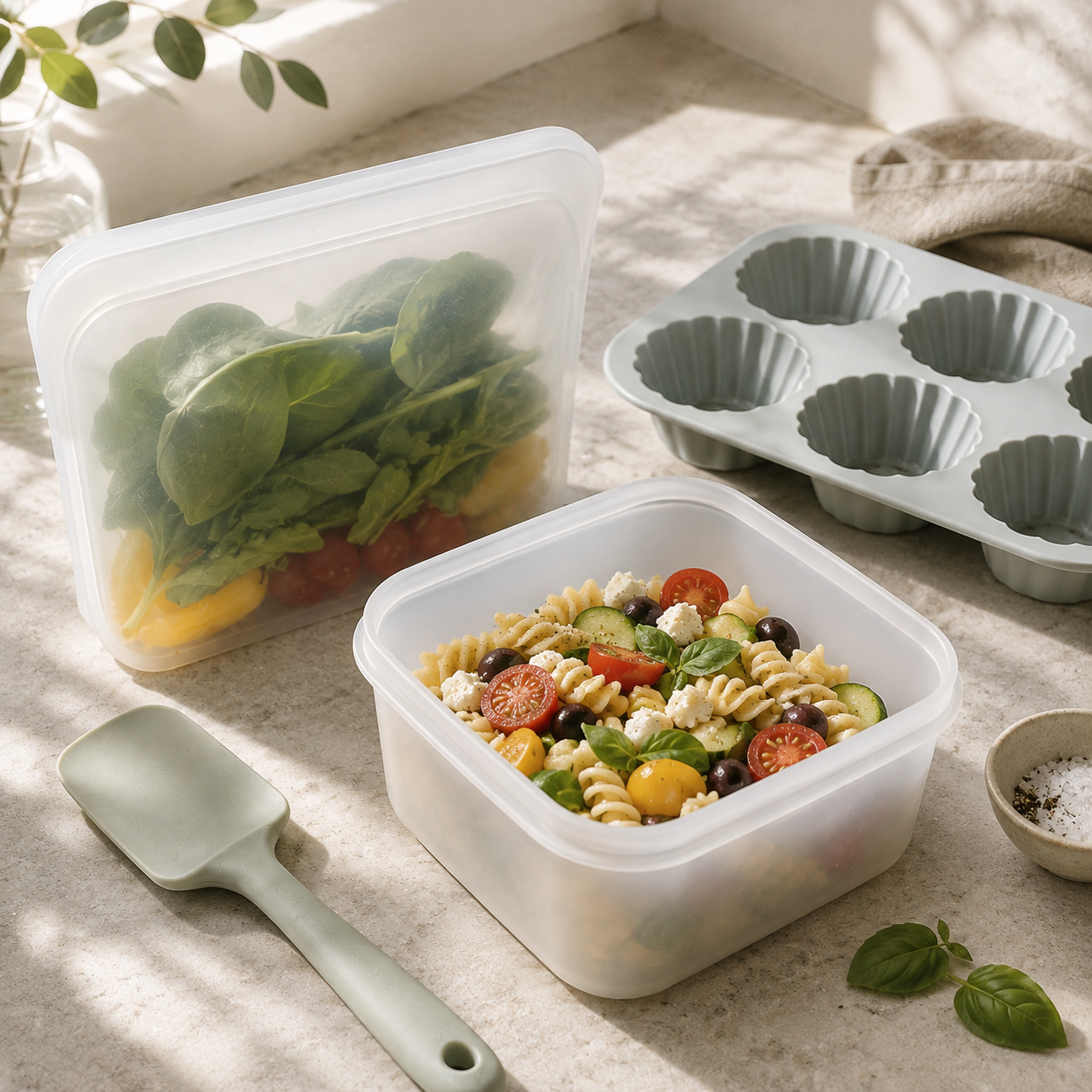
Our Platinum Silicone Food Bags can be used in the:
Pantry. Fridge. Freezer. Microwave. Dishwasher.
They’re also suitable for boiling according to our product instructions.
Instead of buying separate disposable sandwich bags, freezer bags and storage bags, one durable reusable product can do multiple jobs.
Health Canada notes that food-grade silicone is hard-wearing and capable of tolerating extreme temperatures, while also recommending that silicone products always be used according to the manufacturer’s intended-use instructions. [1]
That’s exactly our approach.
Use the product for what it’s designed to do. Wash it. Then use it again.
Is silicone environmentally friendly?
This is another phrase we think deserves a bit of scrutiny.
Silicone isn’t biodegradable.
It takes resources and energy to manufacture.
And although specialist silicone recycling is possible, you generally can’t simply put silicone products into your household recycling bin.
So we’re not going to tell you silicone is environmentally perfect.
The environmental argument for our products is reuse.
If you buy a reusable food bag and use it three times before losing it in the back of a cupboard, we’ve achieved very little.
If you use it hundreds of times instead of repeatedly buying disposable plastic bags, that’s a very different proposition.
Likewise, our coffee cup doesn’t save the world simply because it’s made from silicone.
Its value comes from taking it with you.
Using it.
Washing it.
And taking it again tomorrow instead of accepting another disposable cup.
Why Onya chose platinum-cured silicone
Onya has been making reusable products since 2004.
Our philosophy has never really been about finding a magical “green” material.
It’s about something much simpler:
Replace single-use products with practical reusable products wherever we can.
We chose platinum-cured silicone for our new food bags and collapsible coffee cup because it’s durable, versatile and suited to repeated food contact.
For the coffee cup, there’s another advantage we particularly like: your coffee is held in a silicone vessel rather than sitting against the polyethylene plastic lining found in many disposable paper cups.
And unlike the takeaway cup, you don’t throw ours away when you’ve finished your coffee.
Collapse it.
Pop it back in its pouch.
And use it again.
That’s what Onya is about.

Written by Jennifer Westwood-Andersen