What Is rPET? How Plastic Bottles Become Something Useful Again
If you’ve spent any time looking at reusable bags, backpacks or other everyday products, you may have come across the term rPET.
It sounds technical, but the idea behind it is actually quite simple.
rPET stands for recycled polyethylene terephthalate — recycled PET plastic. PET is the plastic commonly used to make things such as water and soft drink bottles. Instead of that plastic being used once and discarded, it can be collected, processed and turned into material that can be used again.
At Onya, rPET has been part of our products for years. Our reusable shopping bags, produce bags, bulk food bags, bread bags, backpacks and other products are made using recycled PET because we believe that if plastic already exists, finding useful ways to reuse it makes a great deal of sense.
What exactly is PET?
PET stands for polyethylene terephthalate. It’s a lightweight, strong and versatile type of plastic most people encounter every day, particularly in clear beverage bottles and food packaging.
PET is also recyclable.
Once recovered and processed, PET can be made into new bottles and containers, but it can also be turned into fibres used for clothing, carpets, bags and many other products.
When PET has been recycled, it’s commonly referred to as rPET — the “r” simply means recycled.
How does a plastic bottle become fabric?
The transformation from bottle to fabric is surprisingly straightforward.
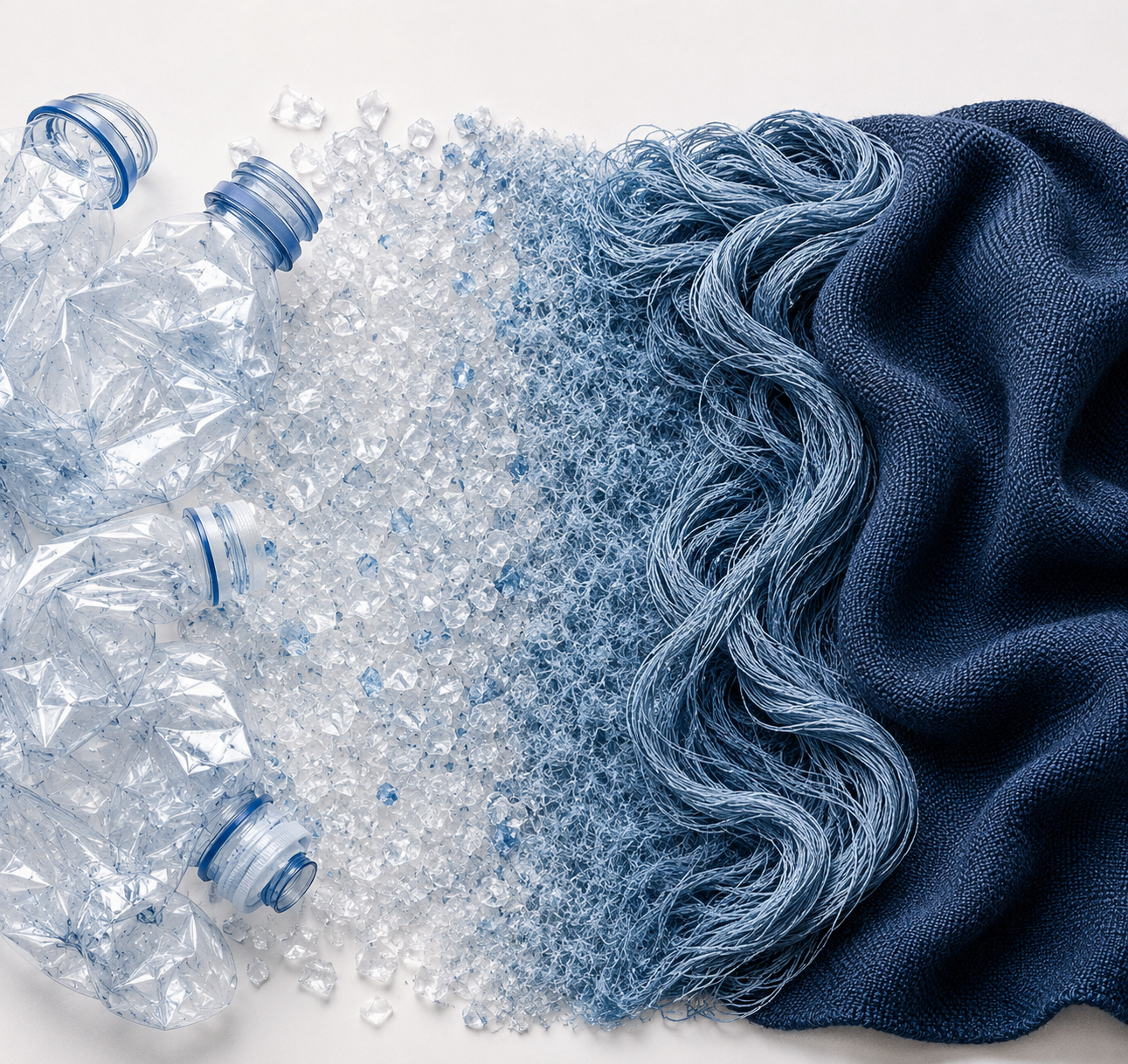
Used PET bottles are collected and sorted before being cleaned to remove labels, lids and contaminants. The bottles are then shredded into small plastic flakes.
Those flakes can be melted and processed into material that is spun into fine fibres. The fibres are then made into yarn, which can be woven or knitted into fabric.
So a bottle that once held water or soft drink can eventually become part of a shopping bag, backpack or produce bag.
There are different methods of recycling PET, including mechanical and chemical recycling. Mechanical recycling — where the plastic is processed, melted and re-extruded — is currently the most common way PET bottles are turned into recycled polyester fibre.
Why use recycled PET instead of virgin polyester?
Polyester and PET are made from the same type of polymer, and conventional polyester is produced using virgin fossil-based raw materials.
Using recycled PET doesn't make plastic disappear, and it isn't a perfect environmental solution. What it does do is make use of plastic that has already been produced, rather than relying entirely on new fossil-based material to make polyester.
That distinction matters.
Recycled polyester is still overwhelmingly made from used PET bottles, although the textile industry is working towards greater textile-to-textile recycling as the technology develops.
For us, the appeal of rPET has always been practical: take an existing waste material and turn it into something durable that can be used repeatedly.
Is rPET still plastic?
Yes.
This is an important point, because we don't think sustainability claims should pretend otherwise.
rPET is recycled plastic. Turning a plastic bottle into fabric doesn't suddenly make it a natural fibre, and products made from rPET should still be used and disposed of thoughtfully.
There is also a broader issue with synthetic textiles: like other polyester fabrics, rPET can shed tiny fibres during use and washing.
So why use it?
Because there is already an enormous amount of plastic in circulation. Recycling some of that material into durable products gives it another useful life and reduces the need to manufacture the same material entirely from virgin resources.
It's not about claiming that recycled plastic solves the plastic problem. It doesn't.
It's about making better use of material that already exists.
Is rPET the same as recycled polyester?
Essentially, yes.
When PET plastic is recycled and made into textile fibre, it is generally referred to as recycled polyester or rPET.
The terminology can be confusing because PET bottles and polyester fabric don't look remotely alike, but chemically they belong to the same polyester family.
That's what makes it possible to turn PET packaging into fibres suitable for fabric.
Can rPET be recycled again?
Potentially, yes, although this is one of the areas where recycling becomes more complicated.
PET itself is highly recyclable, but recycling a clean plastic bottle into another bottle is generally simpler than recycling a finished textile product containing zips, stitching, coatings, dyes or different materials.
Textile-to-textile recycling is developing, but it is not yet available at anything like the scale of bottle recycling.
That's another reason durability matters.
If we're going to turn recycled plastic into a product, we want that product to stay useful for as long as possible.
Why does Onya use rPET?
Our approach has never been about buying a reusable product simply for the sake of owning something labelled “eco-friendly”.
A reusable product only makes sense if you actually reuse it.
That's why rPET works particularly well for many of the products we make. It can be lightweight, strong, washable and durable — all useful characteristics for something designed to be carried around and used again and again.
A plastic bottle has a very short useful life when it's used once.
Turning that material into a shopping bag, produce bag or backpack doesn't undo the fact that the plastic was originally manufactured. But it does give that material another purpose — and potentially years of further use.
And ultimately, that's the point.
Use what already exists. Make it useful again. And keep using it for as long as you can.


Written by Jennifer Westwood-Andersen