Article: Microplastics in Takeaway Coffee Cups: What New Australian Research Found
Microplastics in Takeaway Coffee Cups: What New Australian Research Found

Single-use paper coffee cups release millions of micro- and nano plastic particles into hot drinks, according to new research from the University of Queensland.
Researchers tested two common plastic linings used inside takeaway coffee cups - conventional polyethylene (PE) and biodegradable polylactic acid (PLA). Both released plastic particles into hot water. Surprisingly, the biodegradable PLA-lined cups released considerably more.
We don’t yet know exactly what ingesting micro- and nano plastics means for human health. Research into their effects is still developing.
But we do know something else: microplastics are being found inside the human body.
They’ve been detected in human brains, livers, kidneys and testes. They’ve been found in placentas and amniotic fluid. And recent research has reported microplastics in foetal organs.
So knowing that a disposable coffee cup can add millions more plastic particles to something you’re about to drink is hardly reassuring.
And when the source is something as unnecessary as a disposable coffee cup, there’s an extremely simple way to avoid it:
Don’t use one.
Your paper coffee cup isn’t just paper
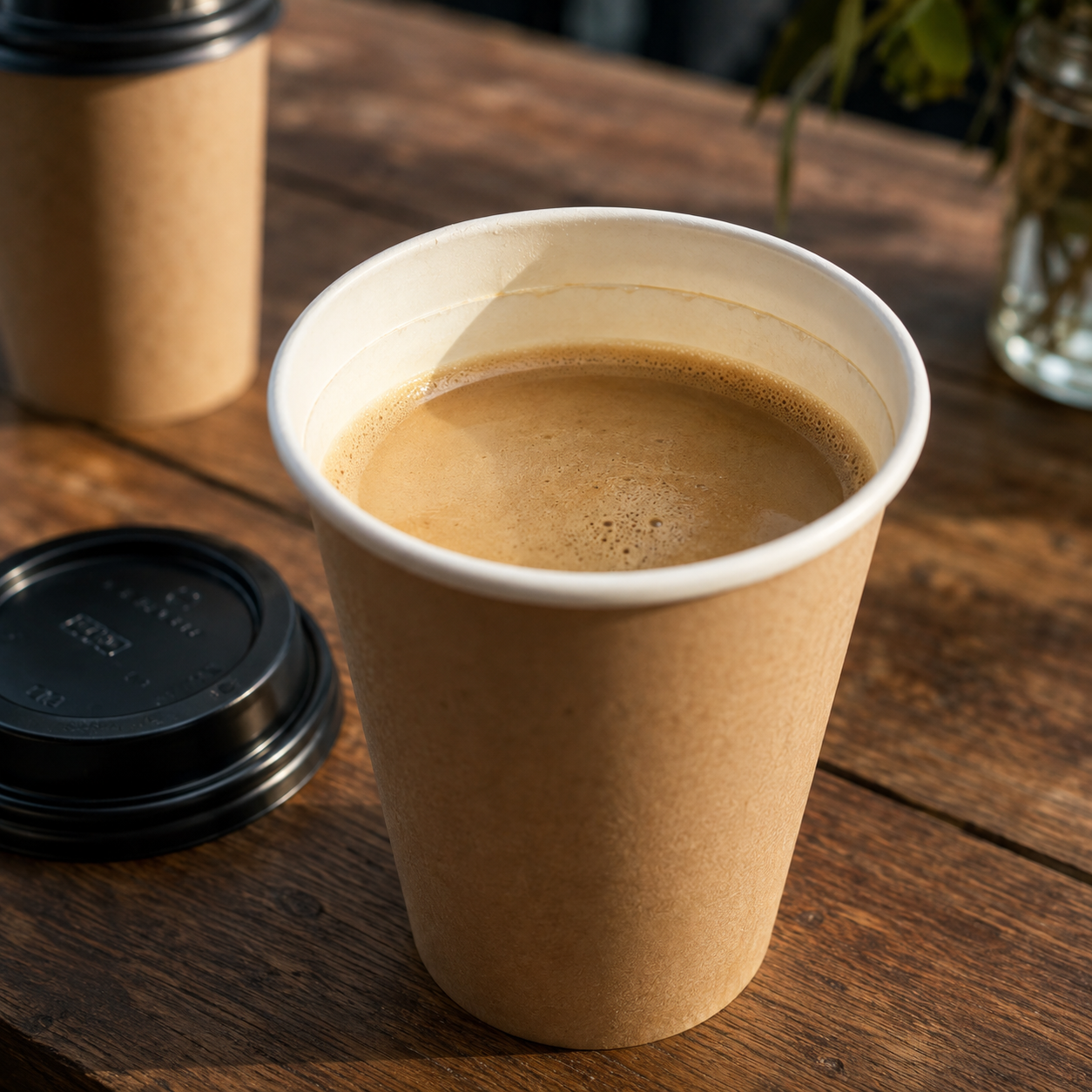
A takeaway coffee cup may look like paper, but the inside tells a different story.
To hold hot liquid without leaking or losing its shape, most paper takeaway cups are coated on the inside with a thin layer of plastic.
The University of Queensland researchers tested cups with two different types of lining:
Polyethylene (PE) - a conventional plastic commonly used in disposable cups.
Polylactic acid (PLA) - a biodegradable plastic often used as a supposedly more environmentally friendly alternative.
When hot water was added, both types released micro- and nano plastic particles into the liquid.
How much plastic are we talking about?
A lot.
The researchers measured approximately 2.7 million nanoparticles per millilitre from conventional PE-lined cups.
From the biodegradable PLA-lined cups, they measured approximately 4.3 million nanoparticles per millilitre.
And when researchers looked at the total mass of plastic particles released, the PLA-lined cups released around 12 times more plastic material than the conventional PE-lined cups under the conditions tested.
That’s worth stopping to think about.
A cup described as paper, biodegradable or compostable can sound reassuring.
But those words don’t necessarily mean plastic-free.
And they certainly don’t mean that plastic isn’t making its way into what you’re drinking.
We’re already finding microplastics inside people
For a long time, the conversation around plastic pollution was largely about what it was doing to our oceans, waterways and wildlife.
Increasingly, researchers are looking at what it may be doing inside us.
Micro- and nano plastics have been detected in human brain, liver and kidney tissue. They have also been reported in human testes and in pregnancy-related tissues and fluids including the placenta and amniotic fluid.
Recent research has gone further. In a small 2026 study examining six foetuses, researchers detected microplastics across the major organs they examined, including the brain, heart, lungs, liver, kidneys and intestine.
That study does not tell us what effects, if any, those particles caused. And scientists are still working to understand the health consequences of long-term exposure to micro- and nano plastics.
Finding plastic in an organ does not prove that the plastic caused disease in that organ.
But “we don’t yet know exactly what it does” isn’t the same thing as “there’s nothing to worry about”.
And reducing unnecessary exposure while scientists continue to work out the consequences seems pretty reasonable to us.
What does this mean for your takeaway coffee?
The University of Queensland study did not prove that drinking from a disposable coffee cup will make you sick.
What it did show is that plastic-lined disposable cups released millions of micro- and nano plastic particles into the hot liquid they contained.
Those are two different statements, and the distinction matters.
But so does the choice we make with that information.
If a product is essential, accepting some level of exposure or environmental impact may involve a complicated trade-off.
A disposable coffee cup isn’t essential.
We already have an alternative.
What about biodegradable coffee cups?
This may be the most surprising part of the research.
It’s easy to assume that choosing a biodegradable takeaway cup solves the problem.
Not necessarily.
PLA is a bioplastic commonly made from renewable plant materials and, under appropriate industrial composting conditions, it can break down differently from conventional fossil-fuel plastics.
But biodegradable does not mean plastic-free.
In the University of Queensland study, the PLA-lined cups didn’t release fewer plastic particles into the hot water.
They released more.
That doesn’t mean every biodegradable cup will behave identically, nor does it mean PLA has been proven dangerous to human health.
But it does challenge the assumption that choosing a “green” disposable cup automatically removes the plastic problem.
The simplest solution? Don’t use a disposable cup
You could spend time trying to work out whether your local café uses PE-lined cups, PLA-lined cups, compostable cups or some other disposable alternative.
Or you could skip the disposable cup altogether.
Take a reusable cup.
Glass, stainless steel, ceramic and silicone are all options. The best reusable cup is the one that works well enough in your everyday life that you’ll actually use it.
At Onya, we’ve spent more than two decades making reusable products because convenience matters. If a reusable alternative is a nuisance to carry or use, people are far more likely to fall back on disposable products.
That’s one reason we chose a collapsible reusable coffee cup made from platinum-cured silicone.
Drink your coffee, collapse the cup, put it back into its reusable pouch and carry on with your day.
No disposable paper cup.
No plastic lining.
No cup thrown away after 20 minutes.
One cup doesn’t feel like much
A takeaway cup seems insignificant because we use it briefly and then it disappears into a bin.
But the numbers add up remarkably quickly.
Buy five takeaway coffees a week and you can get through around 260 disposable cups in a year.
And if plastic-lined cups are releasing millions of micro- and nano plastic particles into hot liquid every time they’re used, that’s potentially hundreds of additional exposures each year from takeaway coffee alone.
Why knowingly add another source of plastic exposure when it’s so easy to avoid?
Switch to a reusable cup and one very small change can eliminate hundreds of disposable cups from your routine - and eliminate the plastic-lined takeaway cup as a source of micro- and nano plastics in your coffee.
We’ve always thought reducing hundreds of disposable cups was reason enough to make the switch.
Now there’s something else to consider.
The problem with a disposable coffee cup may not begin when you throw it away.
It may begin while you’re still drinking from it.
Read the research
This article was prompted by new research from the University of Queensland, published in August 2026, investigating the release of micro- and nano plastics from plastic-lined single-use paper cups.
University of Queensland: “Takeaway cups release microplastics into your coffee”
https://news.uq.edu.au/2026-08-takeaway-cups-release-microplastics-your-coffee
Research into micro- and nano plastic exposure and human health is continuing, and our understanding of the health implications is still evolving.

Written by Jennifer Westwood-Andersen